
Beha’alotecha
To Ascend
To Stand on Your Own
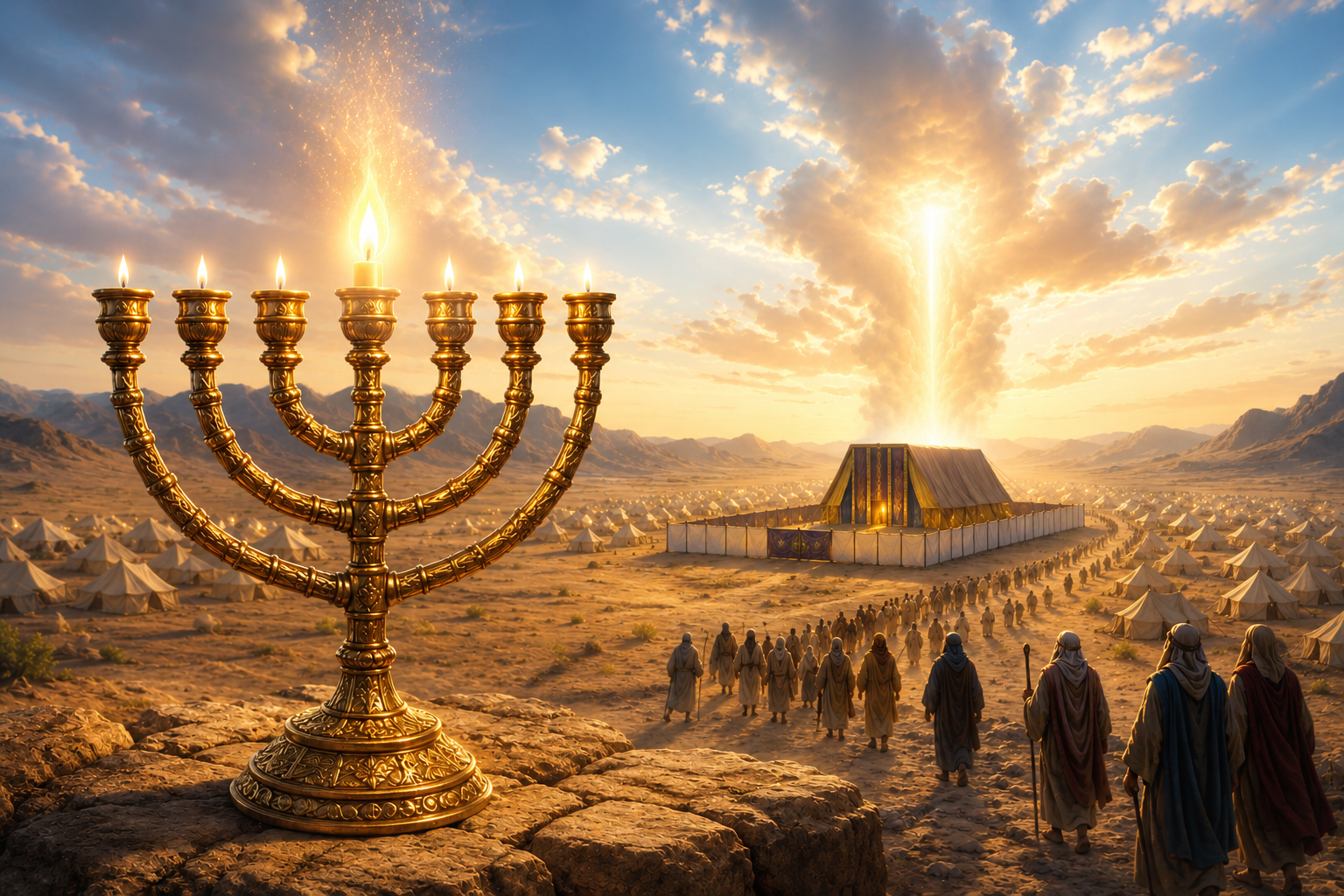
Beha'alotecha commences with Aaron being commanded to light the 7-branched menorah in the Tabernacle. He is commanded using the word "Beha'alotecha", which means, "to cause the candles to ascend" or rise up. The mystics interpret this commandment to mean that Aaron must light the candles until they ascend and remain lit on their own, independent of the source of fire with which they were ignited. This same principle applies when we teach others or help elevate another's soul through love or wisdom. It is not enough simply to hold the fire there, we must help ensure that the person is elevated and can rise on their own, no longer dependent upon us. True connection occurs when each soul can stand independently while remaining united with others
Secret of the Second Pesach
We also read in Beha'alotecha how G-d tells Moses to instruct the Israelites to keep Passover in its anointed season on the 14th day of the first month of Nisan. Moses instructs the people and the holiday was kept according to its ordinances and details. There were certain men however that had become ritually impure from handling a dead body and were not able to make the required Pesach sacrifice due to their state of impurity. They questioned Moses, and G-d told Moses that anyone that is ritually impure or on a journey "far away", that they will keep Pesach the following month on the 14th of Iyar, when they could make the applicable sacrifice.
This second Pesach is called Pesach Sheni. There is a dot over the word "rechokah" (far away) and we can learn from this that no matter how far away we are, either physically or spiritually, if we make the required effort, we will be presented with another opportunity in our lives. Also, on Pesach Sheni, it is for one day and we are able to eat both Chametz and Matzah, hinting to us that when we repent or become clean, we can reconnect in an instant and do not necessarily need to repeat the entire process.
Trust & Certainty
The portion continues and describes how the Israelites journeyed through the desert with the Golden Ark, the Tabernacle (portable sanctuary) and the Second Ark which held the broken tablets. It details how when a cloud covered and settled on the Tabernacle, the Israelites settled camp and when the cloud was taken up, they continued to journey. Regardless of whether the cloud was settled on the camp for one day, one month or one year, the Israelites maintained certainty in G-d's plan and direction.
When we follow the Ark and the Torah, we are protected, enabling us to share and love and find true meaning in our existence. We can make our own plans, but we must have faith that G-d knows when it is time for us to move forward, and when it is time for us to remain still. We saw this play out in our lives with the Coronavirus pandemic. When it was time to encamp, regardless of our plans to the contrary, we remained at home. Let go, let G-d, and have certainty in the universal plan unfolding in our lives.
Appreciation
We read in the 6th section of Beha'alotecha how some of the Israelites (the mixed multitude) began to complain that they did not have meat and reminisced about eating fish and other foods back in Egypt. The manna which they were provided was not good enough and they complained to Moses. Moses told this to G-d who became angered and said through Moses - "you shall not eat [meat] for one day, nor two days, nor five days, neither ten days, nor twenty days, but you shall eat it for a whole month until it comes out of your nostrils and it shall be loathsome to you". He then sent quail for them to eat and "smote" the people who had complained.
We learn here the importance of appreciation. The Israelites had just witnessed miracles and had been delivered by G-d, though Moses' leadership, from slavery in Egypt. It is remarkable how quickly we can forget what we have and become focused on what we lack. When we do not appreciate - whether our relationships, our work or our spiritual connections, our blessings and good fortune can be taken from us in an instant.
Gossip, Leprosy, and the Power to Heal
In the last section of the portion, we read how Miriam gossips to Aaron about Moses' separation from Tzipora, his wife. G-d is angered about the gossip and inflicts Miriam with leprosy. Despite her actions, Moses pleads with G-d to heal her and uses the phrase "el na refa na la", which means "heal her now G-d, I pray you." After 7-days separated from the camp, her leprosy was healed and she was permitted back into the camp.
We can learn two important lessons from this short passage: (1) gossip or evil speech, in Hebrew, "lashon harah", is a terrible act which can result in leprosy or skin disease and should not be engaged in at any time. It hurts three people - the person saying it, the person hearing it and the person about which it is being said; and (2) by praying to G-d and asking for healing, we are able to experience healing in our lives.
Oftentimes we wonder why we are not experiencing blessings or, G-d forbid, why negativity has entered our lives. It is up to us to speak directly to G-d, the Light, or the creator, and ask, in our own words, for what we need - whether healing for ourselves or others, prosperity, guidance, or any other blessing we seek.
Practical Tools for the Week
1. Light Until They Shine
Help someone this week in a way that increases their independence rather than their dependence. Share wisdom, encouragement, or guidance that empowers them to stand on their own.
2. Practice Appreciation Daily
Each morning, identify three blessings in your life before focusing on what is missing. Appreciation expands the vessel for receiving more blessings.
3. Guard Your Speech
Before speaking about another person, ask yourself: Is it true? Is it necessary? Is it kind? Use your words this week to heal, encourage, and unite rather than criticize or divide.
Resources & Credits
The Weekly Wisdom emails and the ideas presented herein are compiled from the following sources:
Gutnick Edition Chumash with Rashi's commentary, Targum Onkelos, and commentary anthologized from Classic Rabbinic Texts and the works of the Lubavitcher Rebbe
Apples from the Orchard - Gleanings from the Mystical Teachings of Rabbi Yitzchak Luria on the Weekly Torah Portion
Kabbalistic Bible - Kabbalah Centre International, Inc
The Zohar - Rabbi Shimon Bar Yochai, various translations
Mysteries of the Kabbalah - Marc-Alain Ouaknin
Wikipedia
Other online written and video content that discusses and shares Kabbalistic Wisdom