
Nitzavim - Vayelech
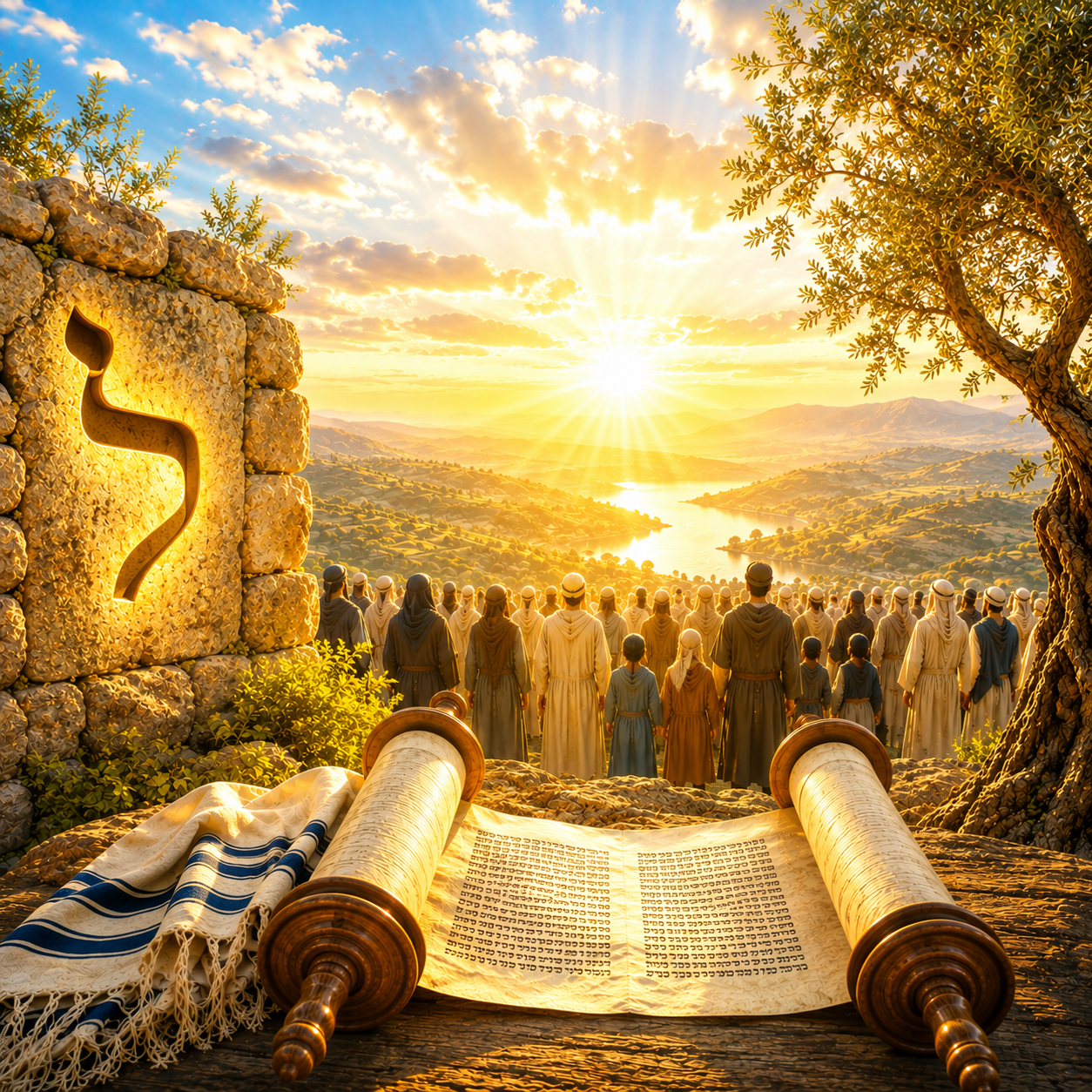
The Power of Unity
Secret Energy for Rosh Hashanah & Tishrei
The portion of Nitzavim is always read on the Shabbat immediately preceding Rosh Hashanah and the new month of Tishrei. Interestingly, the Shabbat before Rosh Hashanah is the only Shabbat where we do not bless the new moon and upcoming month, as we do for all other months of the year.
The Kabbalists explain that this is intentional - to avoid creating an opening and alerting the negative forces and influences surrounding us to interfere with the energy of the upcoming holiday and new month.
However, we are still given an opportunity to connect to the Light of Tishrei through the Torah reading itself. In this portion, we find the unique appearance of an oversized Hebrew letter Lamed. One of the earliest Kabbalsitic texts, the Sefer Yetzirah, explains that the month of Tishrei is associated with the letter Lamed. By connecting to and meditating on the the oversized Lamed, we can connect to the Light and spiritual energy of the new month that we would ordinarily receive by the blessing of the new moon.
Additionally, this portion contains 11 dots written above the words "lanu ul'vanenu", meaning "for us and our children". Dots above letters appear only rarely in the Torah, signaling that there is something deeper to contemplate. The Kabbalists teach that we can connect to the energy of unconditional love - the pure and instinctive love that exists between a parent and child.
Power of Unity
The beginning of this week's reading contains one of the key principles for a successful and meaningful life: the power of unity.
Moses says: “All of you stand before the Lord your G-d: your heads, your tribes, your elders, your officers, and every Israelite man; your young ones, your wives, the stranger in your gate; from your wood-hewer to your water drawer.”
Everyone is included. Leaders and laborers. Young and old. Those at the center of the community and those at its margins. The message is that our collective strength comes from our ability to stand together.
This teaching was not intended only for the people standing in the desert thousands of years ago. It applies directly to our everyday lives.
When we create unity within ourselves - when our thoughts, words and actions are aligned - we become stronger. The same is true of a family, a business, a community or a nation. When people can move together toward a shared purpose, while still maintaining their individuality, they become capable of accomplishing extraordinary things.
It is division, ego and an excessive focus on our individual interests, separate from the greater good, that weaken us.
An old Chasidic story, also reflected in Aesop's fables, communicates this beautifully. A group of quarreling people are told to gather sticks from the forest, with each stick representing one of them. When the sticks are bound together, no one can break the bundle. Separated, each stick can easily be snapped.
The lesson is simple: we are stronger together than we are apart.
Try to create and maintain unity in every aspect of your life.
Closeness of Torah Wisdom
Nitzavim also teaches us something fundamental about the practicality and accessibility of Torah wisdom.
Rather than being an ancient or technical book reserved for scholars and learned Rabbis, the portion makes clear that its wisdom is within our reach:
“For the commandment which I command you this day, it is not beyond you, nor is it remote from you. It is not in heaven and it is not across the sea. Rather, it is very close to you, in your mouth, in your heart, that you may do it.”
There is something incredibly powerful in these words.
Spiritual wisdom is not somewhere far away. We do not need to climb a mountain, cross an ocean or become a scholar to access it. It is already close to us - in what we say, what we feel, the choices we make and how we treat the people around us.
The wisdom of the Torah is practical, accessible and available for all of humanity. Its teachings address the same human experiences we continue to face today - love, fear, ego, anger, gratitude, relationships, purpose and the choices between darkness and Light.
The opportunity is simply to bring that wisdom into our everyday lives.
Always Remember
The portion of Vayelech, which is connected to Nitzavim this week, is the shortest portion in the Torah. Less is often more, and this is no exception. The portion is filled with energy and Light.
Moses announces that he will not travel into the Land of Israel and passes leadership to Joshua in anticipation of his passing. Moses also understands that, with time, the people may forget the miracles they experienced on their journey from slavery in Egypt to freedom and the importance of following the wisdom of Torah.
Vayelech therefore gives us three powerful ways to remember:
1. Gather. The mitzvah of Hak'hel - “to gather” - is introduced. Every seven years during Sukkot, the entire nation of Israel was to gather together and hear the Torah read publicly. There is power in coming together and reconnecting to shared wisdom and purpose.
2. Sing. G-d instructs Moses to write the Song of Ha'Azinu and teach it to the people so that the song will remain with them as a witness and a source of remembrance. There is a reason music can stay with us long after words are forgotten.
3. Write. Finally, we read the Torah's last positive commandment: to write a Torah scroll. What we write becomes something tangible - a lasting reminder that can be returned to again and again.
Gather. Sing. Write.
Three different ways of teaching us the same lesson: do not forget.
It is easy to experience moments of clarity, inspiration and connection. The challenge is remembering them when we return to everyday life.The key message for us is to remember to choose the Light. To take the higher road. To return to wisdom when ego, fear or negativity pull us in another direction.
When we remember, we expand what is possible in our lives. When we forget, we risk limiting ourselves and our potential.
As we enter Rosh Hashanah and a new year, Nitzavim-Vayelech gives us a beautiful reminder to stand together, remember who you are, and choose the Light.
Practical Tools for the Week
1. Create Unity - Identify one relationship in your life where there is tension or distance. Take one action this week to create greater unity. Make the call, let go of the need to be right, listen more carefully, or find the common ground.
2. Create a Reminder - We all have moments of clarity and inspiration - and then life gets busy and we forget. Write down one spiritual principle you want to carry with you this week. Put it somewhere you will see it every day. Create a way to remember.
3. Choose the Light - When you face a difficult interaction or decision this week, stop before reacting and ask yourself: “What is the higher choice?” There is usually a choice between reacting from ego, fear or anger and responding from a higher level of consciousness.
Resources & Credits
The Weekly Wisdom emails and the ideas presented herein are compiled from the following sources:
Gutnick Edition Chumash with Rashi's commentary, Targum Onkelos, and commentary anthologized from Classic Rabbinic Texts and the works of the Lubavitcher Rebbe
Apples from the Orchard - Gleanings from the Mystical Teachings of Rabbi Yitzchak Luria on the Weekly Torah Portion
Kabbalistic Bible - Kabbalah Centre International, Inc
The Zohar - Rabbi Shimon Bar Yochai, various translations
Mysteries of the Kabbalah - Marc-Alain Ouaknin
Wikipedia
Other online written and video content that discusses and shares Kabbalistic Wisdom