
Shemini Atzeret & Simchat Torah
Manifest Your Connection
What is Shemini Atzeret?
Shemini Atzeret, the "Eighth Day of Assembly", is a biblical holiday which immediately follows the seven-day festival of Sukkot. It falls on the 22nd of Tishrei and is celebrated as a one-day holiday in Israel. In traditional observance outside Israel, the holiday extends through the 23rd of Tishrei, with Simchat Torah celebrated on the second day.
The custom of observing two days outside Israel arose from historical uncertainty about when the new month had been declared. Observing an additional day ensured that the holiday included the date established by the Torah. This custom continued after the adoption of a fixed calendar.
Although Shemini Atzeret is connected to Sukkot through its reference to the eighth day, the Torah establishes it as a distinct holiday, on which we recite the She’hechiyanu blessing. Customs concerning eating in the sukkah vary: in Israel, the obligation has ended; outside Israel, many communities eat in the sukkah on Shemini Atzeret without reciting the blessing for dwelling in it. As a separate yet connected holiday, it invites us to consider the relationship between the physical and spiritual realms.
The sages describe this eighth day as one final opportunity for G-d’s people to remain close to Him after Sukkot. While the seventy bulls offered during Sukkot correspond to the seventy nations, the single bull offered on Shemini Atzeret expresses the intimate relationship between G-d and Israel. In Kabbalistic understanding, Sukkot surrounds us with the Light of Mercy, Or Makif. Shemini Atzeret invites us to receive that connection more deeply within ourselves. The word Atzeret carries the sense of pausing or remaining - an invitation to linger in the closeness of the holiday for one more day.
Shemini Atzeret can also be understood as “the silence after the song.” After the crescendo of the High Holidays - the prayers, shofar blasts, fasting, and joy of Sukkot - we are invited simply “to be.” It is the quiet pause where the Light we have drawn throughout the holidays begins to settle into our souls. Just as a melody lingers after the final note, the eighth day is a sacred stillness in which we make room for the Divine Presence within us. It is intimacy without words - as though G-d were saying, “Stay with Me a little longer.”
What is Simchat Torah?
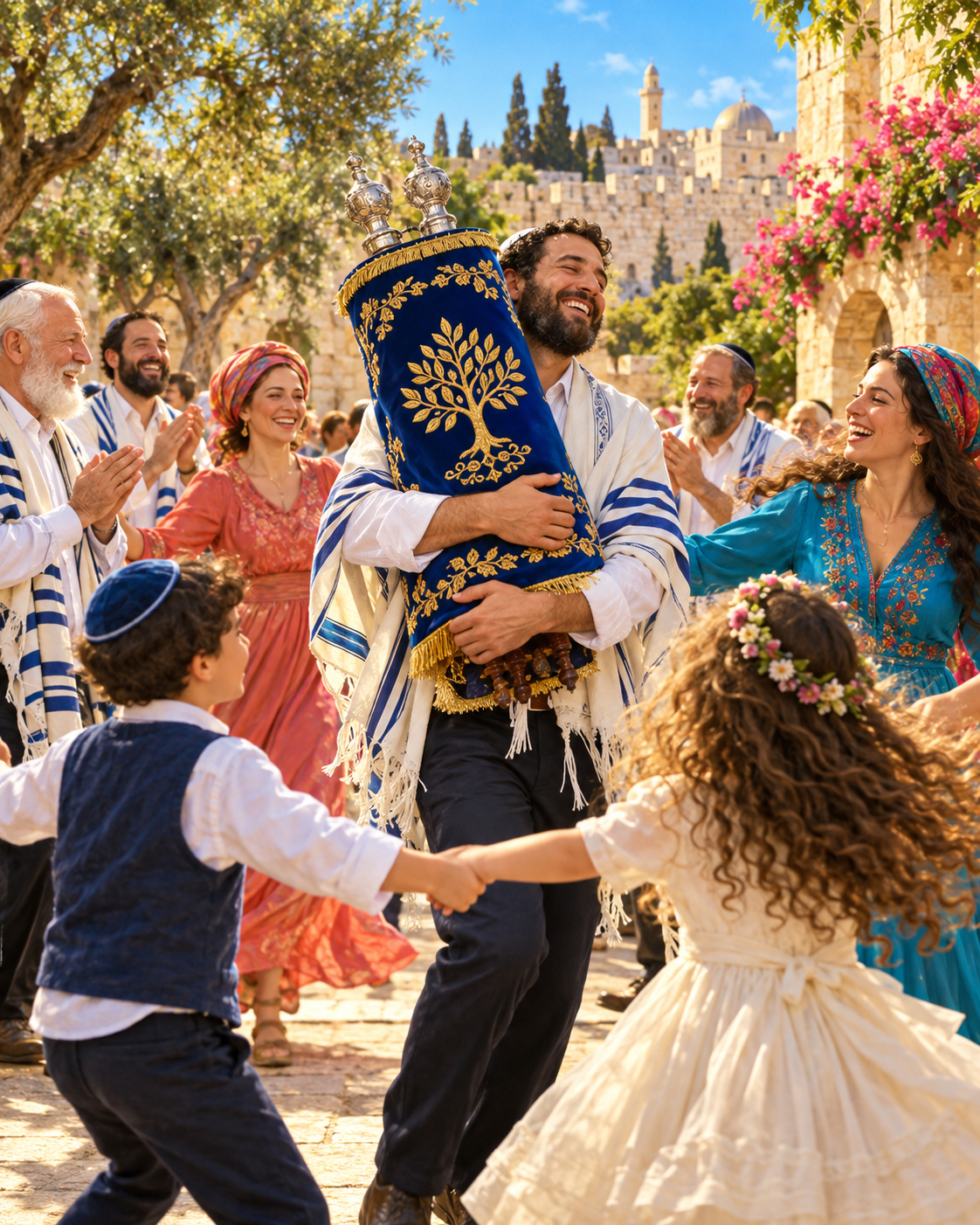
Simchat Torah, “Rejoicing with the Torah,” is a celebration that developed around the completion of the annual Torah reading cycle, followed immediately by the beginning of the next cycle.
In Israel, the practice of reading the end of Deuteronomy and the beginning of Genesis takes place on Shemini Atzeret, so Shemini Atzeret and Simchat Torah are celebrated together. In traditional Diaspora observance, these readings and celebrations take place on the second day of the holiday, known as Simchat Torah.
How Do We Connect?
Hakafot - On Simchat Torah, we celebrate by taking out the Torah scrolls and making seven circuits, called Hakafot, around the bimah in the synagogue. Like the custom in some Jewish wedding ceremonies of a bride circling the groom seven times, these circuits can symbolize a wedding—our renewed commitment to G-d and the Torah.
Through the lens of the Zohar, this is an opportunity to draw divine Light into the vessel we have prepared through Rosh Hashanah, Yom Kippur, and Sukkot. The celebration includes bringing out the Torah scrolls for Hakafot both in the evening and again during the morning services.
Ending and Beginning the Cycle - During the morning celebration, we read the final Torah portion, Vezot Habracha. Unlike the other portions in the annual cycle, its reading is tied to Simchat Torah rather than to a regular Shabbat.
The reading is a joyous occasion, with customs that extend participation throughout the community, including a special moment for children. We complete the final portion and immediately begin Bereshit, the opening portion of Genesis. We connect to the continuity between the completion of one cycle and the beginning of another.
The person honored with the final reading from Deuteronomy is called the Chatan Torah. The person honored with the opening reading from Genesis is called the Chatan Bereshit. These titles, meaning “Bridegroom of the Torah” and “Bridegroom of Genesis,” echo the holiday’s imagery of marriage and renewed commitment.
Prayer for Rain - During Musaf on Shemini Atzeret, we offer a special prayer for rain. Rain is a source of growth and abundance. Spiritually, it can represent the nourishment needed to sustain the inner work of teshuvah we have undertaken throughout the holidays.
As we return to Bereshit, we reconnect to the “seed” of the Torah. Like a seed that needs water, the connection we have cultivated needs ongoing care so that it can grow throughout the new year.
Mystical Insight
Shemini, the eighth day, connects us to the energy of miracles. Seven represents the natural cycle, reflected in the seven days of the week. Eight points beyond that cycle - to possibilities beyond the familiar limits of the natural world. As a visual meditation, an eight turned on its side also evokes the symbol of infinity.
Following the days of judgment at Rosh Hashanah and Yom Kippur and the seven days of surrounding Light and mercy during Sukkot, we can use this eighth day to manifest the connection we have been developing throughout the holidays. Through the simple act of dancing and rejoicing with the Torah, we give physical expression to our spiritual work.
Chasidic teachings draw attention to the way our feet carry even our heads when we dance. The mind cannot contain the endless wisdom of the Torah, yet we can embrace it with our whole being. Our feet—humble and faithful - carry the body, including the head that holds our intellect and doubt. Dancing invites us to move beyond understanding alone and express our connection through joy, movement, and surrender. We allow the Light of the Torah to move through us, bringing our spiritual intentions into physical expression.
The Zohar’s discussion in Parashat Pinchas describes Shemini Atzeret as a union of the spiritual qualities expressed throughout the holidays. The Left, associated with the judgment of Rosh Hashanah and Yom Kippur, and the Right, associated with the mercy of Sukkot, come together through the Central Column. These qualities are brought into balance and unity.
We have sought forgiveness, offered forgiveness, and worked to clear the slate for the new year. During Sukkot, we receive the surrounding Light of mercy. Now, on Shemini Atzeret and Simchat Torah, we seek to bring that Light into our lives. We express our connection physically through singing and dancing with the Torah, and spiritually through returning to Bereshit, the seed of creation that begins the annual reading cycle.
As the Torah begins again with Bereshit, we are reminded that creation is not only a past event but a continuous unfolding. The cycle begins anew, and within it, so do we.
Practical Tools to Connect
1. Pause and Receive — Take a quiet moment to let the blessings and lessons of the holidays settle within you.
2. Express Your Joy — Sing, clap, or dance with gratitude. Let your body express the connection in your soul.
3. Begin Again — Choose one small daily act of learning or kindness to carry the Light of the holidays into the year ahead.
Use these tools and deeper understanding about the holiday to have a powerful Shemini Atzeret & Simcha Torah connection!
Resources & Credits
The Holiday Wisdom emails and the ideas presented herein are compiled from the following sources:
Gutnick Edition Chumash with Rashi's commentary, Targum Onkelos, and commentary anthologized from Classic Rabbinic Texts and the works of the Lubavitcher Rebbe
Apples from the Orchard - Gleanings from the Mystical Teachings of Rabbi Yitzchak Luria on the Weekly Torah Portion
Kabbalistic Bible, - Kabbalah Centre International, Inc
Chabad.org
LiveKabbalah.org
The Zohar - Rabbi Shimon Bar Yochai, various translations
Mysteries of the Kabbalah - Marc-Alain Ouaknin
Other online written and video content that discusses and shares Kabbalistic Wisdom