
Sukkot
A Celebration of Joy and Unity
Energy of Surrounding Light
The holiday of Sukkot is a unique period following Rosh Hashanah and Yom Kippur when we have an opportunity to draw down and experience the energy of "Or Makif", the surrounding Light. Through our spiritual work during the first 10 days of Tishrei, we were able to access our personal "holy of holies", the realm of Binah consciousness - the womb of G-d and place of understanding. The building of a Sukkah - a temporary shelter or hut, is an essential component to the holiday and serves as our vessel that helps to draw down the Light from Binah, bringing blessings to ourselves and others who dwell and connect within the Sukkah.
The holiday begins on the 15th of Tishrei, at the full-moon, when the light of the sun is fully reflected by the moon. The full moon is considered a time when the energy of the sun, represented by the highest level of consciousness, shines upon and connects with the moon, representative of our physical world, so that the moon appears "full", reflecting the full Light of the sun. This signifies a unification of the higher and lower worlds and we have the opportunity to connect to that energy.
Kabbalist Rav Berg further shares that the Aramaic word Sukkah is comprised of four Hebrew letters whose numberical values reveal this same connection. Vav and Kaf, have the numerical value of 26 while Samech and Hei, have the numerical value of 65. 26 is numerical value of the tetragrammaton, the Holy name for G-d associated with the upper worlds, while 65 is the numerical value of the word Adonai, the Holy name for G-d associated with the physical realm. Accordingly, through the Sukkah, we are able to draw down the surrounding Light and bridge the upper and lower worlds, heaven and earth.
The Four Kinds
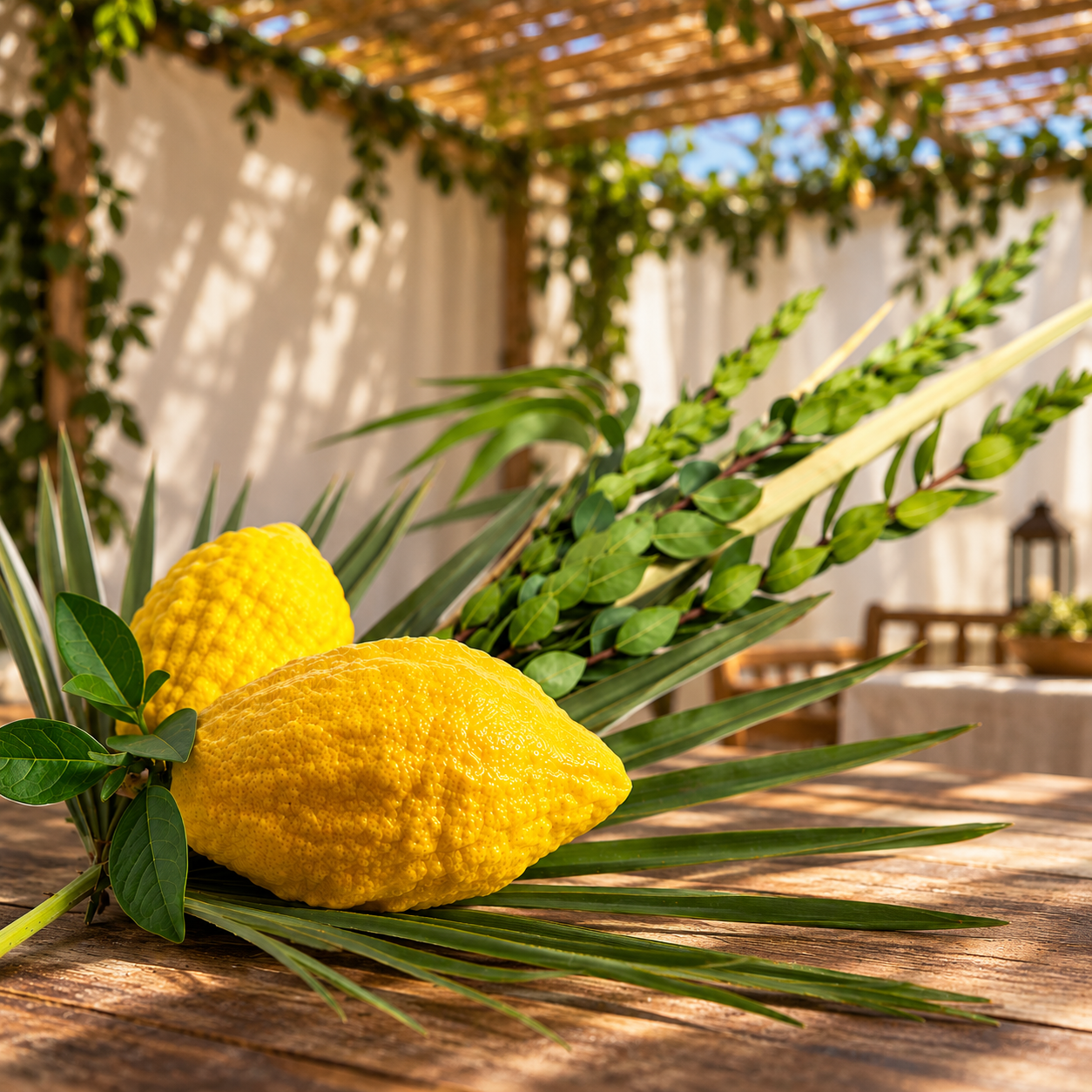
A second aspect to the holiday is to wave the "four kinds". The four kinds are different plant species that correspond to 4 different types of people. By binding them together and waving them in all 6 directions (North, East, South, West, Up and Down), we are reminded that different types of people comprise, and are an integral part of, the unified whole of humanity.
Specifically, the Etrog (citron), has a beautiful taste and smell - representing a person who has a desire to study Torah and possesses good deeds. The Lulav (palm frond) has taste, but no smell - representing a person who studies Torah but does not possess good deeds. The Hadass (myrtle) has smell, but no taste - representing a person who has good deeds, but does not study Torah. Lastly, the Arava (willow) has neither smell nor taste - representing a person who neither learns Torah nor possesses good deeds. By bringing the four kinds together and waving them in the Sukkah, we can connect to the unity among all people around the world.
Unity and Blessings for All Nations
In the time of the great Temple, daily sacrifices were brought as offerings during Sukkot. Over the seven days, a total of 70 bulls were offered. These 70 offerings represented each of the 70 nations of the world - traditionally understood as the nations descended from Noah - and were brought by the Israelites for the wellbeing and peace of all humanity
This cosmic energy exists today, thousands of years later, and while the offerings have been replaced by our prayers and spiritual connections, we still use the joy and connection of Sukkot for the benefit of all of mankind. During the holiday we have the opportunity to create blessings and Light for all the nations of the world.
The Breath of the Sukkah
The Kabbalists teach that the Sukkah is alive — that each breath we take within it connects us to the Ruach Elohim, the Divine Spirit that gives life to all creation. When we enter the Sukkah, we step into a field of Or Makif, the Surrounding Light, and even our breathing becomes a form of connection and prayer.
With every inhale, we draw in Light and renewal; with every exhale, we release doubt and limitation. In this way, the Sukkah becomes more than a shelter for the body — it becomes a place for the soul to experience the rhythm between Heaven and Earth. By breathing consciously and with joy inside the Sukkah, we align our own life force with the eternal breath of the Creator.
Joy, Happiness, & Dwelling
The laws and customs for the holiday are to dwell in the Sukkah, to bless and wave the four kinds and to celebrate with great joy. Since the Light connecting the upper and lower worlds carries the essence and energy of love and happiness, by celebrating with great joy in the Sukkah, and throughout the holiday, we resonate with this same energy and draw it to ourselves and others.
On each of the seven nights of the holiday, it is also customary to invite a holy guest - one of the seven Ushpizin - into the Sukkah (Abraham, Isaac, Jacob, Moses, Aaron, Joseph, and David). We are not merely remembering the holy figures of the past; we are awakening their consciousness within ourselves. The Zoharteaches that each of these souls embodies a unique spiritual energy, and by consciously welcoming them into our Sukkah, we seek to awaken those qulities within ourselves.
When we invite Abraham, we awaken Chesed, unconditional kindness. When we invite Isaac, we strengthen Gevurah, discipline and awe. When we invite Jacob, we harmonize them through Tiferet, beauty and compassion.
The act of invitation opens the gateway for their energy — their Light — to dwell among us and within us. By welcoming the Ushpizin, we transform the Sukkah into a gathering of souls across time, a meeting point between our ancestors and our present selves. The joy we experience becomes a shared celebration between generations — the living and the eternal.
We can also find joy by dwelling in the Sukkah, a temporary structure, and being reminded that our blessings and good fortune are not dependent upon the construction materials, size or comfort of our home, but rather upon the Light and ultimate protection we receive from G-d.
Resources & Credits
The Holiday Wisdom emails and the ideas presented herein are compiled from the following sources:
Gutnick Edition Chumash with Rashi's commentary, Targum Onkelos, and commentary anthologized from Classic Rabbinic Texts and the works of the Lubavitcher Rebbe
Apples from the Orchard - Gleanings from the Mystical Teachings of Rabbi Yitzchak Luria on the Weekly Torah Portion
Kabbalistic Bible - Kabbalah Centre International, Inc
Chabad.org
LiveKabbalah.org
The Zohar - Rabbi Shimon Bar Yochai, various translations
Mysteries of the Kabbalah - Marc-Alain Ouaknin
Other online written and video content that discusses and shares Kabbalistic Wisdom